Procedural Fairness Letters in Canadian Immigration
Getting a letter from Immigration, Refugees and Citizenship Canada (IRCC) asking you to address concerns about your application can feel stressful. While a procedural fairness letter does not always mean your application will be refused, it does show that the officer has found an issue that could impact the result.
A procedural fairness letter gives you an opportunity to understand and answer concerns that may lead to a negative immigration decision. Read every concern and the stated deadline before preparing a response.
At this stage, it is important to respond carefully and with evidence. Make sure you understand what IRCC is worried about, answer each concern directly, and include documents that support your explanation instead of sending a quick reply.
What Is a Procedural Fairness Letter?
A procedural fairness letter in Canada can raise serious concerns. It gives applicants a chance to respond before a final decision is made.
A procedural fairness letter is an opportunity given to an applicant to respond to concerns before an immigration decision is finalized. The concerns can relate to eligibility, credibility, admissibility, documentation, employment history, relationships, or information that appears inconsistent with the application.
The letter will usually identify the concerns that require a response, but the level of disclosure required depends on the circumstances and the applicable legal duty of fairness. Review the letter and the record carefully so you can address misunderstandings, provide missing evidence, and explain information that was unclear in the original application.
Why IRCC Issues a Procedural Fairness Letter
Canadian law requires procedural fairness, but the exact protections depend on each situation. The Supreme Court of Canada says that procedural fairness is flexible and depends on the type of decision, the laws involved, and how it affects the person.
These procedural fairness protections are meant to give you a real chance to present your side. In immigration, this means you can reply to concerns before an officer makes a decision that could have a big impact on you.
Concerns about possible misrepresentation can be particularly serious. IRCC states that applicants remain responsible for the information in their applications, even when a representative prepares the application. False or altered information may lead to refusal and other consequences, including a ban from Canada of at least five years (IRCC: Consequences of immigration and citizenship fraud).
The important point is that receiving the letter gives you an opportunity to respond before a final decision is made.

Procedural Fairness Protections Under Canadian Immigration Law
In practice, the duty generally requires notice of the case to be met and a meaningful opportunity to respond. What fairness requires can vary with the decision, the statutory scheme, the importance of the decision to the person affected, legitimate expectations, and the procedure chosen by the decision maker (Baker v. Canada).
These procedural fairness protections are intended to give an affected person a meaningful opportunity to present their case. In immigration matters, that can mean responding to a concern before an officer makes a decision that could significantly affect the applicant.
However, procedural fairness does not guarantee approval. It gives the applicant an opportunity to be heard and requires the decision-making process to be fair in the circumstances.
How to Respond to a Procedural Fairness Letter
A procedural fairness letter reply sample can help explain the basic structure. Your response should still reflect your own circumstances.
Start by reading the letter carefully. Identify every concern raised by the officer and deal with each one separately. A strong response should not simply repeat information from the original application.
Instead, explain what happened, include evidence that supports your explanation, and link it to the officer’s concern. If something in your original application was wrong, do not ignore it. Be honest about the mistake and give context if needed.
You can include documents such as job records, financial proof, letters, ID, or anything else related to the concern. The aim is not to send too much paperwork, but to give helpful evidence that answers the officer’s questions.
If the concern may involve immigration misrepresentation in Canada , professional legal advice is especially important, as the consequences can be serious.
Response Deadlines and Timelines
A response to a procedural fairness letter in Canada must meet the stated deadline. Missing the deadline can leave concerns unanswered.
The deadline will be stated in the letter. Do not assume that you have a standard number of days to respond.
Check the deadline carefully and give yourself enough time to collect evidence, get translations if needed, and write a clear response. If you are unsure about the deadline or process, ask for help right away instead of waiting until the last minute.
Common Mistakes to Avoid
A common mistake is replying emotionally instead of focusing on the officer’s real concern. Another mistake is giving a long explanation without any proof.
You should also avoid skipping tough questions, giving information that does not match, or making new claims without proof. Most importantly, never send fake or changed documents. IRCC warns that false information and documents can have serious consequences. (canada.ca)
Not sure how to respond to your procedural fairness letter?
Book a consultation with our immigration lawyers.
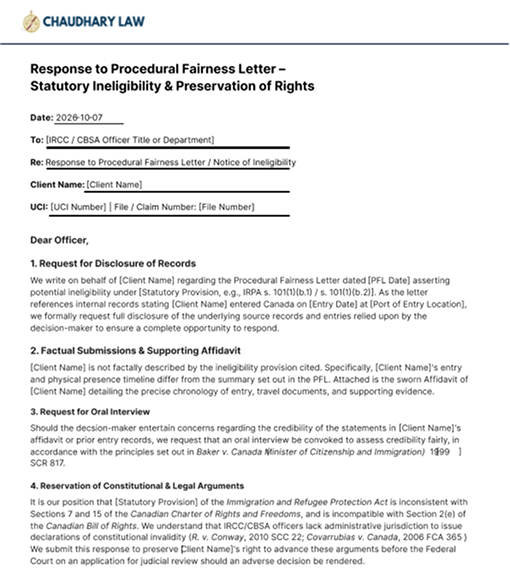
Procedural Fairness Letter Reply Sample
A procedural fairness letter reply sample demonstrates the structure of a response without encouraging applicants to copy someone else’s circumstances or arguments.
Because every case is different, the strongest response will be built around the concerns the officer actually identifies. It should normally identify the issue, provide a clear explanation, and reference the evidence supporting that explanation.
A procedural fairness letter reply sample can make the process easier to understand. Use examples for guidance, not as a template for your own case.
Illustrative framework only: The sample below is not legal advice and should not be copied without adapting it to the officer’s actual concerns, the governing legislation, the evidence, and the applicant’s circumstances. A lawyer should verify any statutory, constitutional, or procedural argument before submission.
MPNP Procedural Fairness Letters
MPNP Procedural Fairness Letters may be issued when Manitoba’s Provincial Nominee Program identifies concerns regarding an applicant’s eligibility, information, or supporting evidence.
Manitoba’s published policy says an applicant has 30 days from the date of the letter to submit additional information. It describes the PFL as the applicant’s only opportunity to address the Program’s concerns; if no response is received, a recommendation is made using the information already on file (Manitoba Immigration: Procedural Fairness).
The response should address the specific concerns raised by the program rather than simply repeating the original nomination application. Provincial nominee matters can also affect the related federal immigration application, so the timing and content of the response warrant careful attention.
If you receive a provincial fairness letter, review the entire document before deciding how to proceed.

Received a Procedural Fairness Letter from a Provincial Nominee Program?
Talk to a lawyer before you reply.
What Happens If You Don’t Respond
If no response is received by the stated deadline, IRCC or the relevant program may decide the application using the information already available. That can increase the risk of refusal where the concern could have been addressed with evidence or an explanation.
Consequences and Refusal Risk
A negative decision can affect an immigration application and, depending on the circumstances, may create further immigration consequences. The appropriate next step after a refusal depends on the type of application, the decision, and the legal issues involved.
In some situations, options may include reconsideration or an application for Judicial Review. These are not automatic remedies, however, and strict legal requirements can apply.
For immigration matters under the Immigration and Refugee Protection Act, an application for leave and judicial review ordinarily must be filed within 15 days for a matter arising in Canada or 60 days for a matter arising outside Canada. Extensions may be available in special circumstances, but immediate legal advice is important (Federal Court: How to file an immigration judicial review).


Procedural Fairness Letter Success Stories
Real outcomes can be useful for showing why a carefully prepared response matters, but they should never be treated as guarantees. Every application turns on its own facts and evidence. Procedural fairness letter success stories can show how strong responses helped applicants. Each case depends on its own facts and evidence.
Any published example should be anonymized and fact-checked, identify the concern raised, summarize the evidence submitted, state the procedural result without implying a guarantee, and confirm that the outcome depended on that client’s facts.
Common-Law Relationship Timing: After an officer questioned whether a couple became common-law before the sponsor landed in Canada, a structured submission detailing the relationship timeline and records proved the legal threshold had not been met at the alleged date, allowing the file to proceed.3
Third-Party Allegations: Rebutted unreliability of third-party claims regarding a sponsor’s prior marriage, preventing a finding of misrepresentation under s. 40.3
Foreign Criminal Allegations: Demonstrated that overseas conduct did not satisfy the Canadian legal threshold for serious criminality.3
Judicial Review Settlement: In cases where an officer issued a refusal without considering a timely submitted PFL response, initiating Federal Court judicial review prompted IRCC legal representatives to offer an out-of-court settlement to reopen and re-examine the file.
Why Work With an Immigration Lawyer for Your Procedural Fairness Letter Response
Responding to an immigration concern is different from simply completing an application form. A lawyer can review the officer’s concerns, assess the evidence, and help organize a response that directly addresses the issues raised.
Legal guidance can also be useful where the concern involves credibility, admissibility, or potential misrepresentation. If a refusal has already occurred, the available options may include Immigration Appeals, depending on the type of decision and the applicant’s circumstances.
Appeal rights are created by statute and do not apply to every immigration refusal. An appeal, judicial review, and reconsideration are different procedures; the available route depends on the decision, the applicant’s status, and any applicable deadlines.
An experienced Canadian Immigration Lawyer can also help you understand whether the response should focus on correcting a factual misunderstanding, providing additional evidence, or challenging the interpretation of the information already submitted.
The same careful approach applies across different immigration matters, including a Canada Visitor Visa. A well-prepared application or response should always be based on the applicant’s actual circumstances rather than a generic template.

Received a procedural fairness letter?
Don’t risk your application, book a consultation today.
Testimonials












Frequently Asked Questions
What is a procedural fairness letter from IRCC?
It is a communication that gives an applicant an opportunity to respond to concerns before IRCC makes a potentially negative decision.
How long do I have to respond to a procedural fairness letter?
The deadline is stated in the letter and can vary. Applicants should follow the specific deadline provided rather than relying on a general timeframe.
What happens if I don't respond to a procedural fairness letter?
IRCC may proceed with a decision based on the information already available, which can increase the risk of refusal where the concerns remain unresolved.
Can I see a sample procedural fairness letter reply?
The illustrative framework above can help show how a response may be organized. It is not a substitute for a fact-specific response to the concerns in the applicant’s own letter.
What are procedural fairness protections in Canadian immigration law?
They generally provide an affected person with an opportunity to understand the case they must answer and to make meaningful submissions, with specific requirements depending on the circumstances.
What is an MPNP procedural fairness letter?
It is a letter from Manitoba’s Provincial Nominee Program identifying concerns that could affect a provincial nomination. Manitoba’s published policy generally gives the applicant 30 days from the date of the letter to respond and says the decision will consider information submitted within that period.
What mistakes should I avoid when replying to a procedural fairness letter?
Avoid ignoring concerns, submitting unsupported claims, providing contradictory information, or missing the stated deadline.
Does a procedural fairness letter mean my application will be refused?
No. It means the officer has identified a concern that may affect the application and is giving you an opportunity to respond.
Should I hire a lawyer to respond to a procedural fairness letter?
You are not always required to have legal representation, but professional advice can be valuable when the concerns are complex or potentially serious.
How can a Canadian immigration lawyer help with my procedural fairness letter?
A lawyer can review the concerns, assess supporting evidence, and help prepare a focused response addressing the issues raised by the officer.

Sources and review
This page should be reviewed by a Canadian immigration lawyer before publication and updated when the governing law or program guidance changes.
Primary sources: IRCC fraud and misrepresentation guidance; Manitoba Immigration procedural fairness policy; Baker v. Canada; Federal Court immigration judicial review guide.
Our Service Areas
- Richmond Hill
- Hamilton
- Toronto
- Kitchener
- Vaughan
- Mississauga
- Newmarket
- Niagara Falls
- Ajax
- North York
- Oshawa
- Peterborough
- Waterloo
- Windsor
- Markham
- Orillia
- North Bay
- Barrie
- Oakville
- Kingston
- Pickering
- Brampton
- Etobicoke
- Scarborough
- Guelph
- Sudbury
- Brantford
- Burlington
- Belleville
- Thunder Bay
Canadian immigration insights, straight to your inbox.
Free weekly insights from Max Chaudhary, featured in Toronto Star, CTV News, and The Guardian.