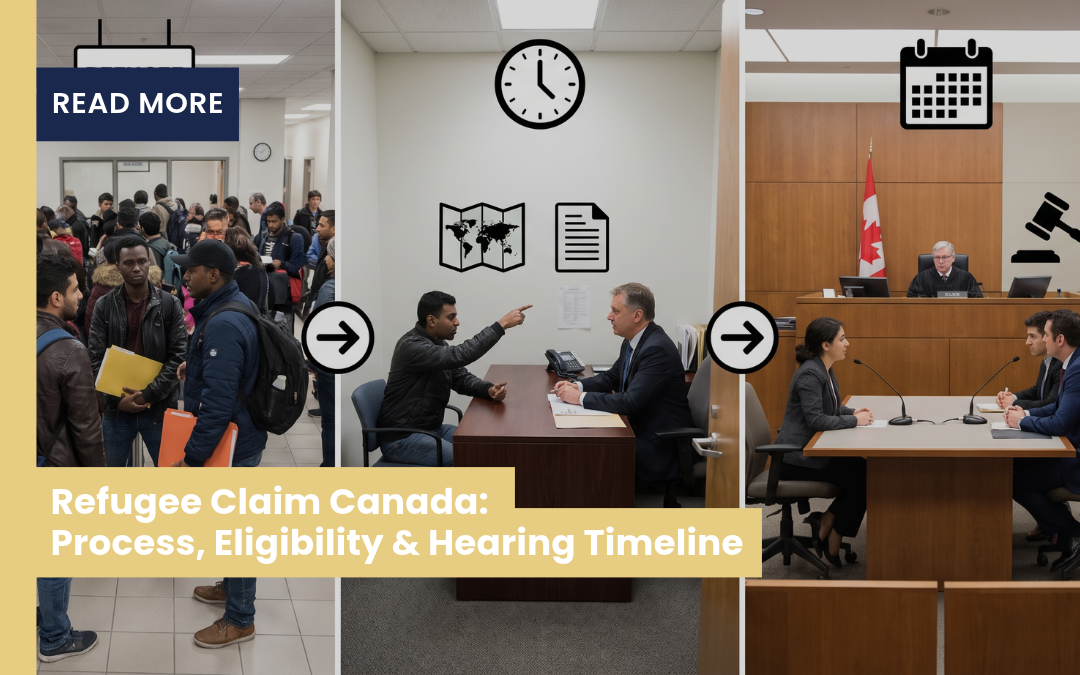
If you fear persecution or serious harm if returned to your country, you may be able to seek refugee protection in Canada. Start by recording when you first entered Canada, how you entered, and when you started your claim. Those details can affect whether the Immigration and Refugee Board can hear your case.
This guide explains how to make a refugee claim in Canada under the 2026 rules, what to include in your Basis of Claim information, and what to do if you receive a hearing notice or a refusal.
What Is a Refugee Claim in Canada?
A refugee claim application in Canada allows someone in Canada or arriving at its border to request protection from being returned to an unsafe country.
Convention Refugee vs. Person in Need of Protection
A ‘convention’ refugee is one who fears persecution on grounds of race, religion, nationality, political opinion, or membership of a particular social group.
A person in need of protection faces a personal risk of torture, danger to life, or cruel and unusual treatment if returned home.
Who Decides: IRCC, CBSA, and the Immigration and Refugee Board
- IRCC: Handles inland applications and eligibility assessments.
- CBSA: Processes border claims and conducts eligibility screening.
- IRB: Independently decides eligible claims through its Refugee Protection Division (RPD).
Who Is Eligible to Make a Refugee Claim?
Understanding the requirements for refugee eligibility in Canada is essential before applying.
Grounds for a Convention Refugee Claim
Applicants must have a well-founded fear on grounds of recognition, i.e., race, religion, nationality, political opinion, or membership in a particular social group.
Risk of Torture or Risk to Life and Cruel Treatment
Applicants may be eligible if returning home would put them at risk of torture, of danger to life or of cruel, inhuman or degrading treatment or punishment.
Situations That Make a Claim Ineligible
A claim may be ineligible for referral if you already have protected person status in Canada, previously made a Canadian claim that was rejected, withdrawn, abandoned or found ineligible, or can return to a country that recognizes you as a Convention refugee. A prior claim in a country that shares asylum information with Canada, or certain security, human rights, serious criminality or organized crime grounds, may also make you ineligible.
Safe Third Country Agreement and Its Exceptions
The Canada–U.S. Safe Third Country Agreement generally applies when someone claims protection at a land port of entry from the United States or soon after crossing between ports of entry, including through waterways. Exceptions can apply for qualifying family members in Canada, certain unaccompanied minors, eligible document holders and limited public-interest cases.
Time Limits and Other Recent Eligibility Changes
For claims made on or after June 3, 2025, Bill C-12 generally bars referral if you claim more than one year after your first entry into Canada after June 24, 2020. Leaving and returning does not restart that clock. A separate rule applies after the 14-day period for those who entered between Canada–U.S. land ports of entry. Exceptions apply, including for certain unaccompanied minors and some claimants who started in time under the new process.
Where and How to Make a Refugee Claim
Knowing how to claim refugee status in Canada depends on where the applicant is located.
At a Port of Entry
Tell a CBSA officer at a Canadian airport, seaport or land port of entry that you want to claim asylum. If the officer confirms initial eligibility under the current process, follow the Notice of Application Due Date and complete the claim in the IRCC Portal.
Inside Canada (Online or at an IRCC Office)
If you are already in Canada, start your claim in the IRCC Portal and attend the appointment specified in your instructions. The process introduced November 3, 2026 uses the same online completion steps for new inland and port-of-entry claims.
What Happens at the Eligibility Interview?
An officer will verify the identity, immigration history, travel history and reasons for seeking protection. It’s absolutely vital that the answers are honest and consistent.
Refugee Claim Process Step-by-Step
The process for a refugee claim in Canada involves several stages.
Step 1 – Make the Claim and Complete Intake
Submit the required information through the relevant online or border process.
Step 2 – Biometrics, Medical Exam, and Security Screening
Applicants may be required to provide fingerprints, photographs, a medical exam and background checks.
Step 3 – Eligibility Decision and Referral to the IRB
Eligible applications are passed on to the Refugee Protection Division (RPD) for a protection decision.
Step 4 – Complete and File the Basis of Claim (BOC) Form
Explain why you need protection in the Basis of Claim information. Under the November 3, 2026 process, you usually complete this information in Part 2 of your online claim before referral. Follow your own filing instructions if your claim began under the earlier process.
Step 5 – Gather Evidence and Prepare for the Hearing
Gather evidence such as police or medical records, threatening messages and witness statements. If your claim was referred on or after November 3, 2026, the RPD generally must receive your personal evidence within 30 calendar days after referral. Check the practice notice and instructions for your file, including separate deadlines that may apply to country-condition documents.
Step 6 – Attend the Refugee Protection Division (RPD) Hearing
The claimant answers questions about who they are, what they’ve done, and why they fear going back home.
Step 7 – Receive the Decision
The RPD will either accept or reject the claim. Some of the decisions are made without an oral hearing.
The Basis of Claim (BOC) Form: Why It Matters So Much
The Basis of Claim form explains the applicant’s personal circumstances and reasons for needing protection.
Deadline to File
For new inland and port-of-entry claims under the November 3, 2026 process, the Notice of Application Due Date sets a 60-day deadline to complete Part 2 in the IRCC Portal. If you need more time, request the one-time 30-day extension in the portal before the original deadline. Follow the instructions for your specific file if you started under the earlier process.
Writing a Clear, Consistent, Credible Narrative
Describe the events in chronological order. Include the dates, locations, threats and any attempts to obtain protection. Don’t speculate when in doubt.
Changes and Amendments to Your BOC
Correct any errors and bring any significant new information to light immediately, with an explanation as to why the amendment is required.
Refugee Hearing Timeline: What to Expect
The refugee hearing timeline depends on the complexity of the case and IRB workload.
From Claim to Hearing Date
After referral, the RPD reviews the application and schedules a hearing. There’s no guarantee as to how long the process will take.
Fast-Track and Expedited Processes
Some claims are eligible for streamlined processing or can be accepted without an oral hearing.
Why Wait Times Vary
Incomplete documents, security checks, complex evidence, and heavy scheduling pressure can all cause delays.
The RPD Hearing Itself
An Immigration and Refugee Board hearing allows applicants to explain their circumstances before an independent decision-maker.
What Happens in the Hearing Room?
The RPD member will assess the claim and ask questions. The claimant may also be questioned by their representative and, where appropriate, the Minister’s counsel.
Credibility, Identity, and Evidence
The member will assess whether the account is consistent and is supported by the evidence available to them (i.e. ID documents and country reports).
Interpreters and Vulnerable Claimants
Interpreters are available as needed. Further procedural arrangements may be in place to assist children and vulnerable applicants.
Living in Canada While Your Claim Is Pending
Claimants can access certain temporary benefits while they await a decision.
Work Permit and Study Permit
Eligible applicants can apply for a work permit (though they must obtain it prior to working). A study permit is generally required for any program of more than 6 months.
Health Care (Interim Federal Health Program)
The Interim Federal Health Program provides eligible claimants with temporary medical cover (consultations, hospital cover and certain medications).
Housing and Settlement Support
Settlement agencies can help with temporary accommodation, food, employment resources and other basic services.
Restrictions on Travel
Leaving Canada can have an impact on a pending claim, and returning to the country of alleged persecution may itself create major problems.
What Happens After the Decision?
If Your Claim Is Accepted: Protected Person Status and PR
Successful applicants will be granted protected person status and, in most cases, can apply for permanent residence.
If Your Claim Is Refused: Appeal to the Refugee Appeal Division (RAD)
Eligible claimants can appeal certain decisions to the Refugee Appeal Division. Generally, the notice of appeal is due within 15 days and the appellant’s record within 45 days.
Judicial Review at the Federal Court
A judicial review lawyer can assess whether the decision involved a reviewable legal or procedural error.
Pre-Removal Risk Assessment (PRRA) and Other Options
Depending on the circumstances, someone facing removal may qualify for a Pre-Removal Risk Assessment. Restrictions and waiting periods apply.
Common Mistakes That Hurt Refugee Claims
Missed Deadlines and Incomplete Forms
If you miss deadlines or leave important sections blank, your case could be delayed or even abandoned.
Inconsistencies Between Forms, Interviews, and Testimony
If your dates or explanations do not match, it can hurt your credibility. Always check your information carefully before submitting.
Lack of Supporting Evidence
Give as many relevant documents as you can. If you cannot provide important evidence, explain why.
Refugee Claim Examples
These hypothetical situations show how refugee claims might work in practice.
Example 1 – Claim Made at a Port of Entry on Political Grounds
Someone reports threats and physical attacks because of their political activities. The CBSA checks if they are eligible before possibly sending the case to the RPD.
Example 2 – Inland Claim After Arriving on a Visitor Visa
A visitor faces religious persecution and applies from inside Canada, including evidence to support their claim.
Example 3 – Claim Refused at the RPD and Appealed to the RAD
An applicant thinks important evidence was missed. If they are eligible, they can appeal the decision to the RAD.
Why Choose Chaudhary Law Office?
Refugee proceedings are inherently sensitive and involve a very complex set of requirements. Seeking professional legal advice can help you assess eligibility, organise your evidence, build your case, and understand your options.
At Chaudhary Law Office, we help claimants with eligibility, applications, hearing preparation, and appeals. Our team knows how important it is to present a clear and well-supported case.
Whether you’re starting an application or dealing with a refusal, our refugee protection lawyers can help you see your options and decide what to do next.
Bottom Line
If you are unsure whether your claim is eligible, have received a deadline notice, or need to prepare for a hearing, book a consultation with Chaudhary Law Office. Have your entry dates, IRCC or CBSA notices, and any hearing or decision documents on hand so we can identify the next deadline and assess your options.
Early legal advice can go a long way to avoiding all sorts of problems. Contact Chaudhary Law Office for legal guidance on your refugee claim. Call 416-447-6118 to speak about your situation and see how we can help.
FAQs
Who can make a refugee claim in Canada?
People who are at risk of persecution, torture or a risk to their life or to suffering cruel and unusual treatment in their home country may qualify, subject to Canada’s refugee protection eligibility requirements.
How do I make a refugee claim in Canada?
You can make a refugee claim at an eligible Canadian port of entry or from within Canada via the IRCC Portal, depending on your circumstances and eligibility.
What is the Basis of Claim (BOC) form and when is it due?
Your Basis of Claim information explains why you need protection and sets out the facts that support your claim. For new claims under the November 3, 2026 process, provide it in Part 2 of the IRCC Portal by the deadline in your Notice of Application Due Date. If you started under the earlier process, use the instructions for your file.
How long does a refugee claim take in Canada?
Processing time varies depending on the complexity of the claim, the level of eligibility screening, the amount of documentation required, the evidence required, and RPD hearing availability.
What happens at a refugee hearing?
At a refugee hearing, an independent RPD member reviews your evidence, asks questions about your circumstances and decides whether you meet Canada’s legal test for refugee protection.
Can I work while my refugee claim is pending?
Yes. You may be eligible to apply for an open work permit while your refugee claim is being processed, subject to meeting the applicable requirements.
Can I be removed from Canada while my claim is pending?
Generally, eligible refugee claimants are protected from removal while their claim is pending. Exceptions and certain circumstances may affect this protection.
What is the Safe Third Country Agreement?
The Safe Third Country Agreement is an arrangement between Canada and the United States requiring certain asylum seekers to claim protection in the first country they reach, subject to exceptions.
Can I make a refugee claim if I entered Canada a long time ago?
Possibly. However, Canada’s one-year restriction on certain refugee claims may affect your eligibility, depending on when you entered Canada and whether you previously made a claim.
What happens if my refugee claim is refused?
Keep the written reasons and record when you received them. If you have a Refugee Appeal Division appeal right, the notice of appeal is generally due within 15 days and the appellant’s record within 45 days after you receive those reasons. If there is no appeal right, get prompt advice on Federal Court judicial review and any removal deadlines.
Can I apply for permanent residence after a refugee claim is accepted?
Yes. If your refugee claim is accepted, you generally become a protected person and can apply for Canadian permanent residence, subject to applicable requirements.
Do I need a lawyer for a refugee claim?
You are not legally required to hire a lawyer, but an experienced immigration lawyer can help prepare your claim, organise evidence, meet deadlines, and represent you during proceedings.